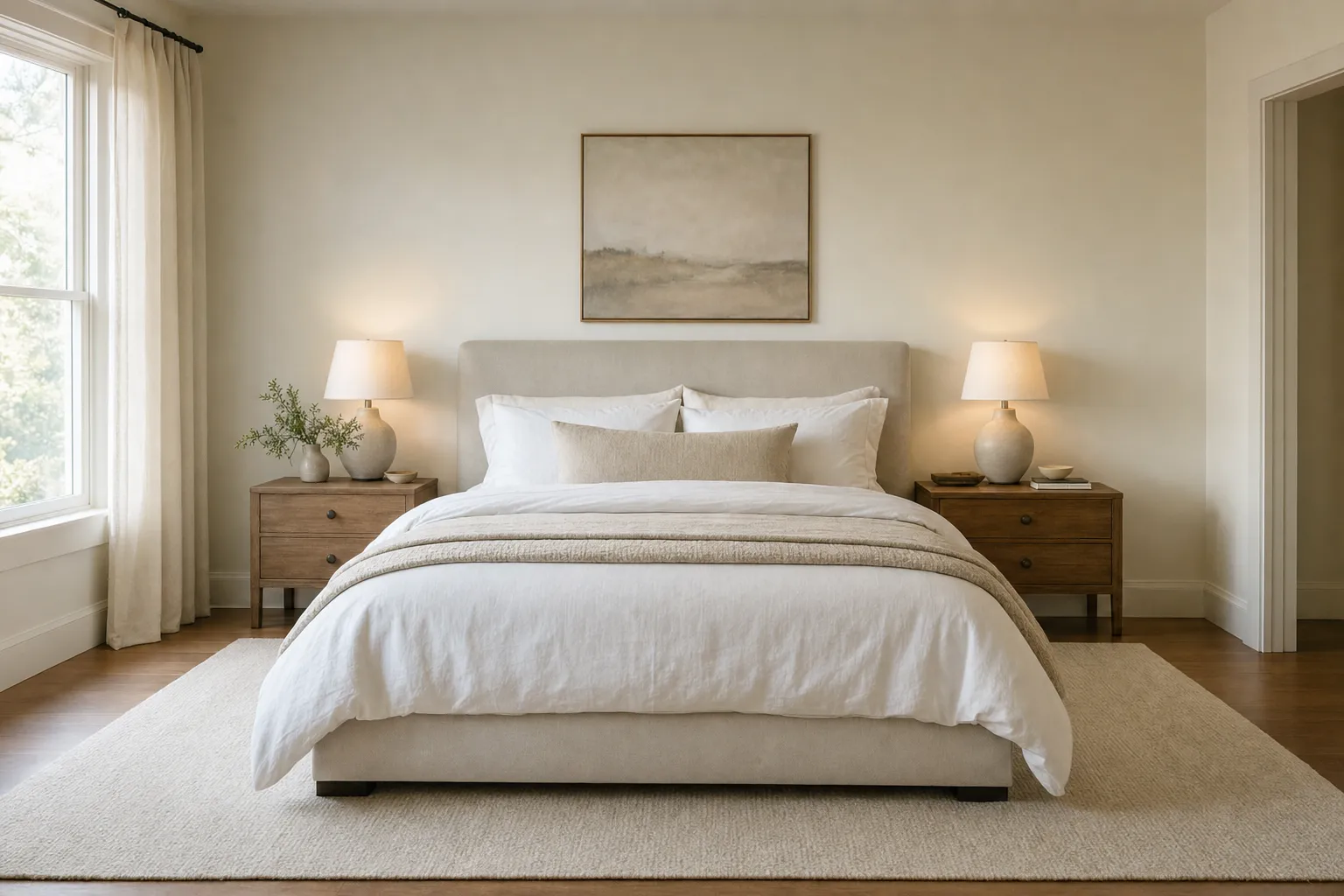
To decorate a bedroom, start with the bed: choose its position first, then plan clear space around it, control light and noise, and build a calm palette with layered textiles, soft lighting and a few personal pieces on the walls. A bedroom is the most private room in the house, so it should be designed for rest first and appearance second. The classic design books agree on this point, and it applies whether your taste is classic or modern.
This guide covers the theory from foundational design books, a practical method with measurements, and two complete style guides: a classic bedroom and a modern bedroom.
Key takeaways
- Place the bed first; everything else follows.
- Leave about 24 to 36 inches of clear space around the bed.
- Choose a rug that reaches at least 18 inches past each side of the bed.
- Control daylight with curtains or shades that can darken the room.
- Use soft, warm, low light in the evening.
- Classic bedrooms are symmetrical, layered and upholstered.
- Modern bedrooms are simple, low and warmed with texture.
The theory: what the great design books teach about bedrooms
Edith Wharton and Ogden Codman Jr.
The Decoration of Houses · 1897
The book devotes a chapter to bedrooms and treats them as private rooms, arranged for comfort and practical use rather than for display to visitors.
In your bedroom: That idea is the starting point of any good bedroom: it is designed for the people who sleep there, not for guests.
Elsie de Wolfe
The House in Good Taste · 1913
Simplicity, suitability and proportion.
In your bedroom: In a bedroom, suitability means practical questions first. Do you read in bed? Do you need a desk or a dressing area? Do you share the room? The answers decide the furniture before any style choice.
William Morris
The Beauty of Life (lecture) · 1880
Useful or beautiful: nothing else belongs in the house.
In your bedroom: Visual clutter is the enemy of a restful room. Clear surfaces, closed storage and a short list of objects you truly love make the room calmer.
“Have nothing in your houses that you do not know to be useful, or believe to be beautiful.”
Christopher Alexander and colleagues
A Pattern Language · 1977
Bed Alcove describes the comfort of a bed in a sheltered, partly enclosed position rather than exposed in the middle of an open room. Couple's Realm argues that a shared bedroom needs a zone that feels private to the couple.
In your bedroom: A bed placed against a solid wall, with a headboard and framing elements on each side, feels more protected and more restful.
Francis D. K. Ching
Interior Design Illustrated · 1987
Balance, symmetrical and asymmetrical, as a core principle, together with scale.
In your bedroom: The bedroom is where symmetry comes most naturally: a centered bed, two nightstands, two lamps. Scale matters too: a king bed in a small room, or a tiny headboard on a large wall, both look out of proportion.
Terence Conran
The House Book · 1974
Storage as a central part of design, not an afterthought.
In your bedroom: Plan closets, dressers and under-bed storage before choosing decorative pieces. A room with nowhere to put things will never look calm.
Ilse Crawford
A Frame for Life · 2014
Design for how a space feels, through all the senses.
In your bedroom: The bedroom is the room you experience most directly: the weight of a blanket, a rug underfoot in the morning, the quality of light when you wake up. Choose materials by touch as well as by look.
Before you buy anything: plan the bedroom
1. Decide what the room needs to do
Besides sleeping, a bedroom may need to hold clothes, a reading chair, a desk, a dressing area or a TV. List the functions and check them against the space available.
2. Measure the room and choose the bed size
Measure the room, the doors, the closet doors and the windows. Standard US mattresses are about 60 x 80 inches for a queen and 76 x 80 inches for a king. Choose the largest bed that still leaves comfortable space around it. In a small bedroom, a queen with slim nightstands often works better than a king.
3. Place the bed first
The bed is the focal point. The most restful position is usually against a solid wall, with a view of the door without being directly in line with it. Avoid placing the bed under a window if you can, since it brings drafts and light straight onto your head.
Clearance around the bed
24 to 36 in
On the sides and at the foot, wherever people walk.
Nightstands
Mattress height
Level with the top of the mattress, or within a couple of inches.
Rug under the bed
At least 18 in per side
Under the lower two thirds of the bed; 12 inches is the minimum that still works.
Art above the bed
2/3 of headboard width
Hung about 8 to 10 inches above the headboard.
Reading lamps
Shoulder height
Bottom of the shade roughly at your shoulder when you sit up in bed.
In front of a dresser
About 36 in
So drawers open fully and you can stand in front of them.
Widely used rules of thumb, not strict rules. Adjust them to your room.
Try it with your room
Bedroom rug and space check
Pick your bed to see how far each standard rug reaches past its sides, and how much floor you keep.
| Rug | Lengthwise, per side | Crosswise, per side | Verdict |
|---|---|---|---|
| 5 x 8 ft | narrower than the bed | 18 in | Generous |
| 6 x 9 ft | 6 in | 24 in | Generous |
| 8 x 10 ft | 18 in | 30 in | Usual pick |
| 9 x 12 ft | 24 in | 42 in | Generous |
| 10 x 14 ft | 30 in | 54 in | Generous |
Floor on each side of the bed
42 in
Comfortable: room for nightstands and a clear path.
Rules of thumb for planning. Measure your space before you buy.
The seven layers of a well-decorated bedroom
Layer 1: The bed and headboard
The bed sets the style of the room. An upholstered headboard adds softness and makes the bed feel anchored; a wood headboard adds warmth; a simple platform bed reads as modern.
Layer 2: Bedding
Bedding is the largest textile surface in the room. A simple formula: good sheets in a natural fiber such as cotton or linen, a duvet or quilt, a throw at the foot of the bed, and two to four pillows. Keep the base neutral and add color with the throw and decorative pillows.
Layer 3: Light control and lighting
Curtains or shades that can darken the room are essential. For artificial light, use soft, warm bulbs of about 2700K, bedside lamps or wall sconces for reading, and a dimmable ceiling light. Avoid relying on a single bright overhead light in the evening.
Layer 4: Color
Soft, muted colors tend to feel most restful: warm whites, beige, sage green, soft blues and muted earth tones. The 60-30-10 guideline works here too. Darker colors can also make a bedroom feel cozy and enveloping, especially on the headboard wall.
Layer 5: The rug
A rug softens the first step of the morning and makes the room quieter. Place it so you step onto it when you get out of bed. Bedroom rugs are one of the fastest growing bedroom searches this year.
Layer 6: Wall decor
Bedroom wall decor is among the most searched bedroom topics. The wall above the headboard is the natural place for it: one large artwork, a pair of prints, a large mirror or a textile hanging. Keep it calm; the bedroom is not the place for your loudest piece.
Layer 7: Storage and personal objects
Closed storage keeps the room restful. On display, keep a few objects that matter to you: books, a photo, a plant. Apply Morris's test to every surface.
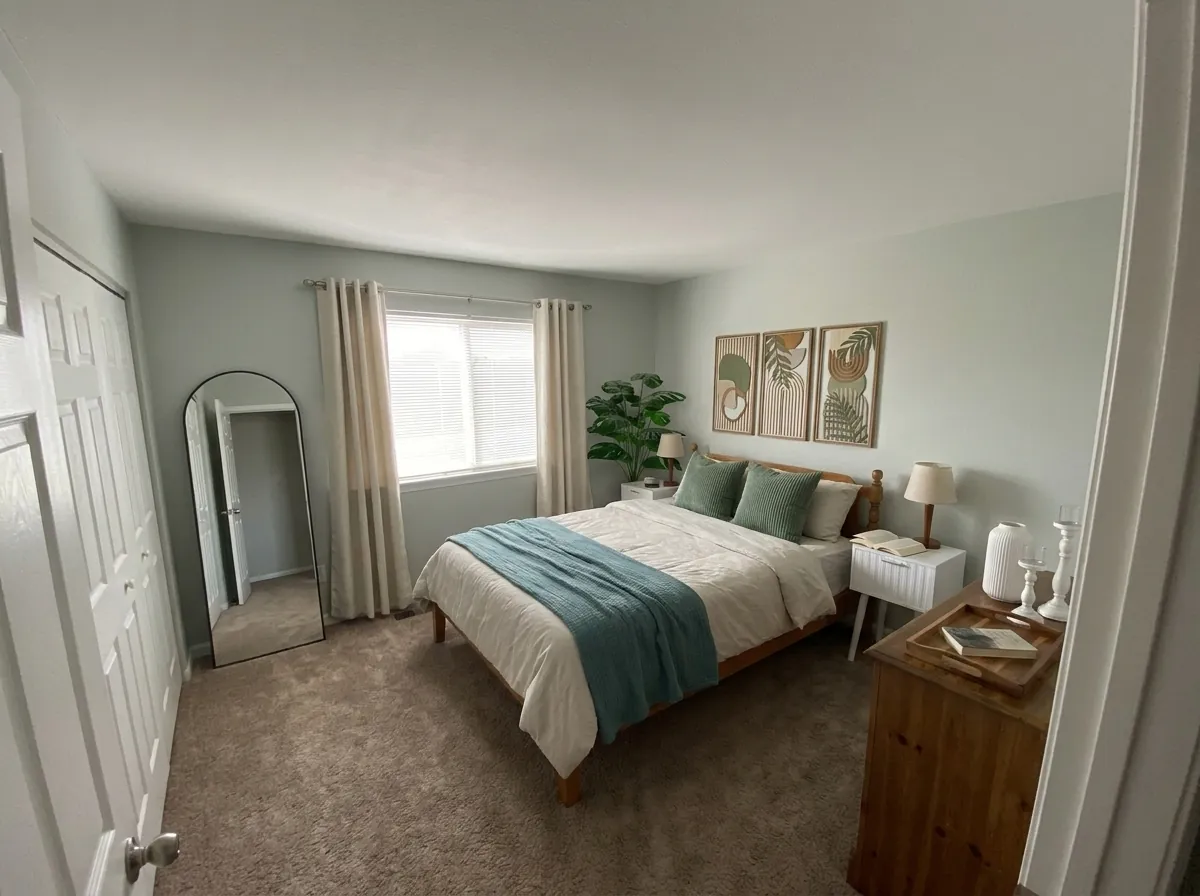 After
After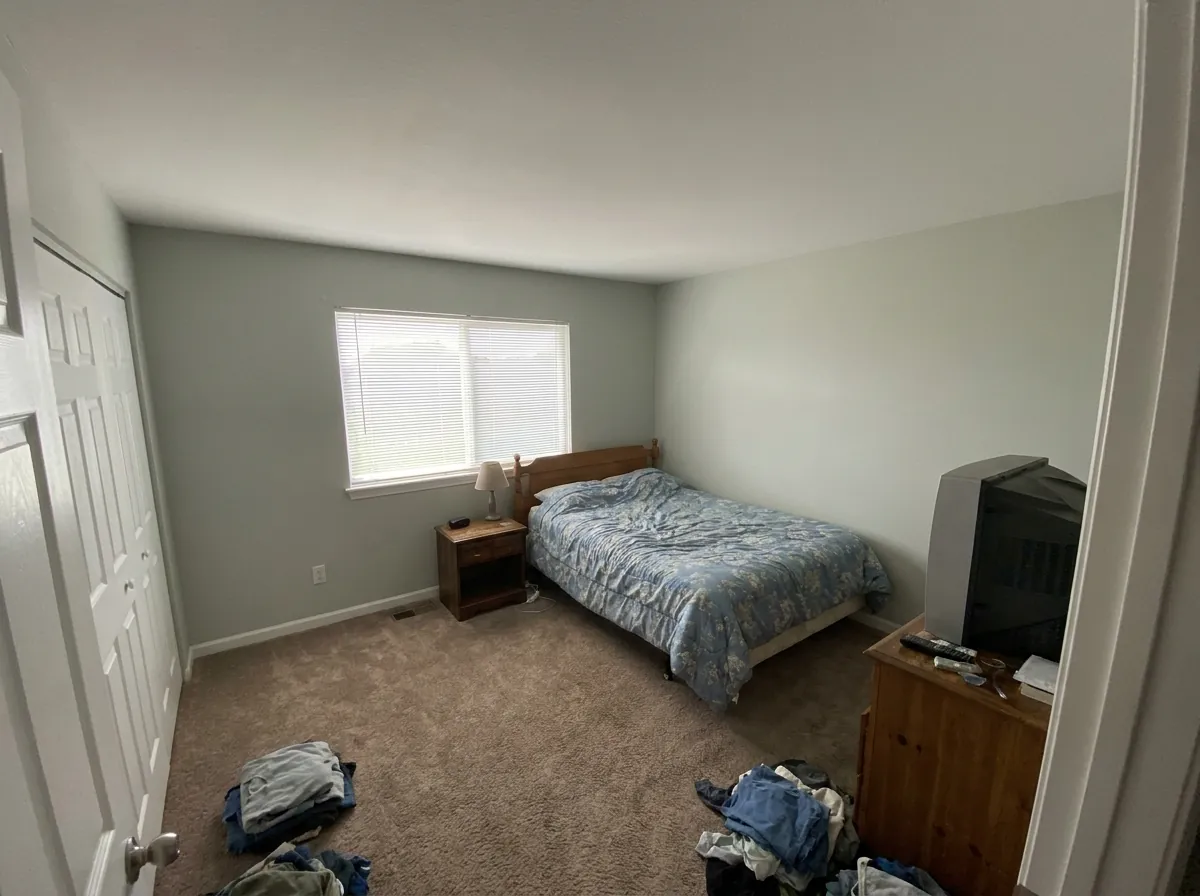
How to decorate a classic bedroom
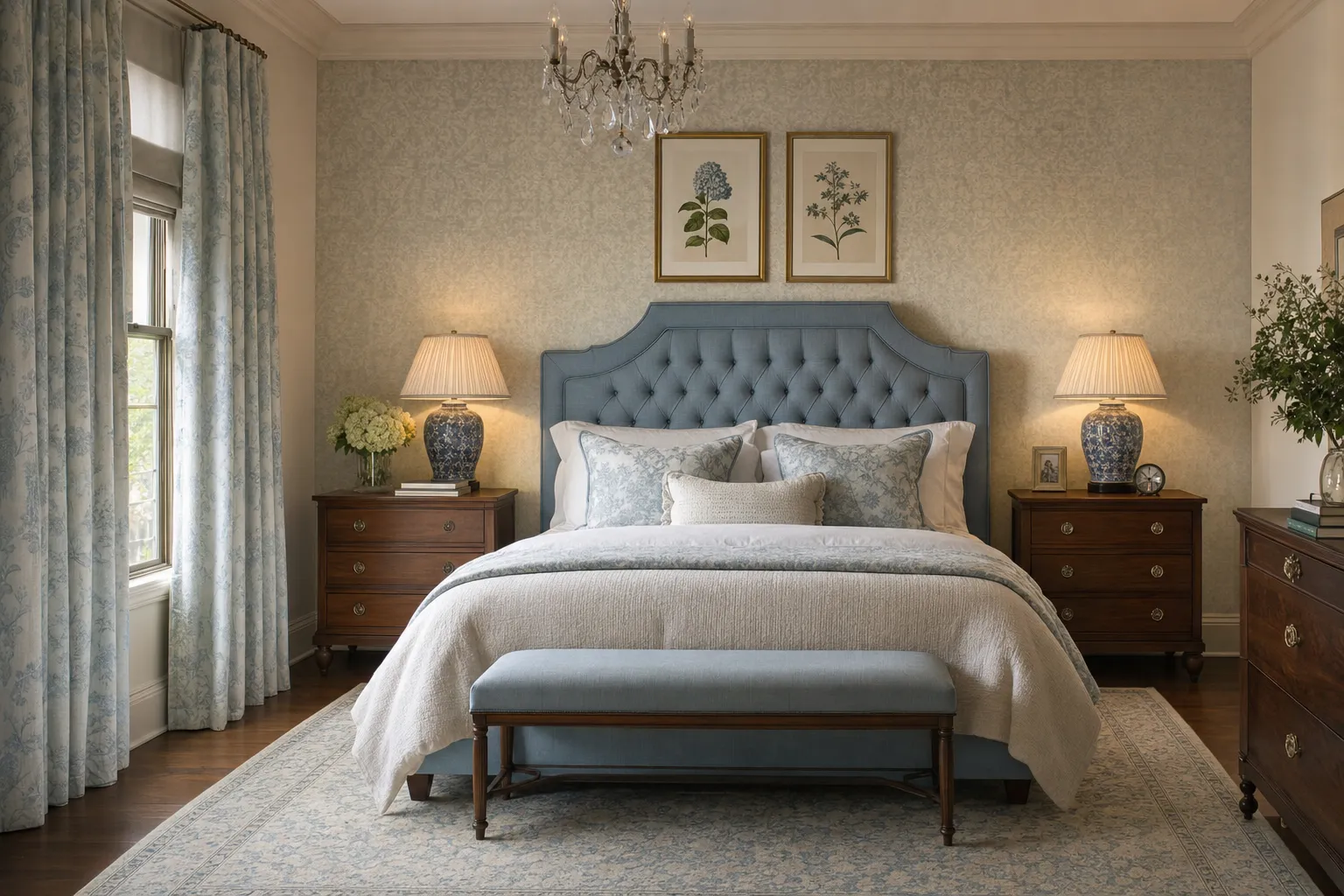
A classic bedroom, also called a traditional bedroom, feels layered, soft and orderly. It borrows from European and early American interiors and often looks like a well-kept hotel suite.
The principles of classic style
- Symmetry. A centered bed with matching nightstands and lamps on each side.
- Layering. Several layers of bedding, curtains and rugs create richness.
- Upholstery. Upholstered or carved headboards, a bench at the foot of the bed, a comfortable armchair.
- Quality materials. Wood, brass, linen, cotton and wool.
Color palette
Soft classic palettes, such as ivory with pale blue, cream with sage green or taupe with soft rose, or deeper tones like navy and burgundy for a more enveloping room. Patterns include small florals, toile, stripes and damask.
Furniture
- A bed with an upholstered, tufted or carved wood headboard; a four-poster or canopy bed in larger rooms.
- Matching nightstands, often with drawers.
- A dresser or chest in a warm wood.
- An upholstered bench at the foot of the bed.
- A reading chair with a small side table.
Lighting
Table lamps with fabric shades on both nightstands, a small chandelier or traditional ceiling fixture, and possibly sconces on either side of the bed.
Walls and windows
A framed artwork or a pair of framed prints above the bed, a mirror above the dresser, and full-length curtains in linen or velvet, lined for light control. Wallpaper with a soft pattern suits classic bedrooms well.
How to keep a classic bedroom fresh
- Avoid matching bedroom sets; mix wood tones and pieces.
- Keep the bedding crisp and light, even if the furniture is dark.
- Add one modern element, such as a simple lamp or an abstract print.
Checklist: classic bedroom
0 of 6
How to decorate a modern bedroom
Modern bedroom decor is one of the fastest rising bedroom searches in the United States this year. A modern bedroom is simple, uncluttered and calm, and it follows the same principles as a modern living room: function first, fewer and better pieces, clean lines.
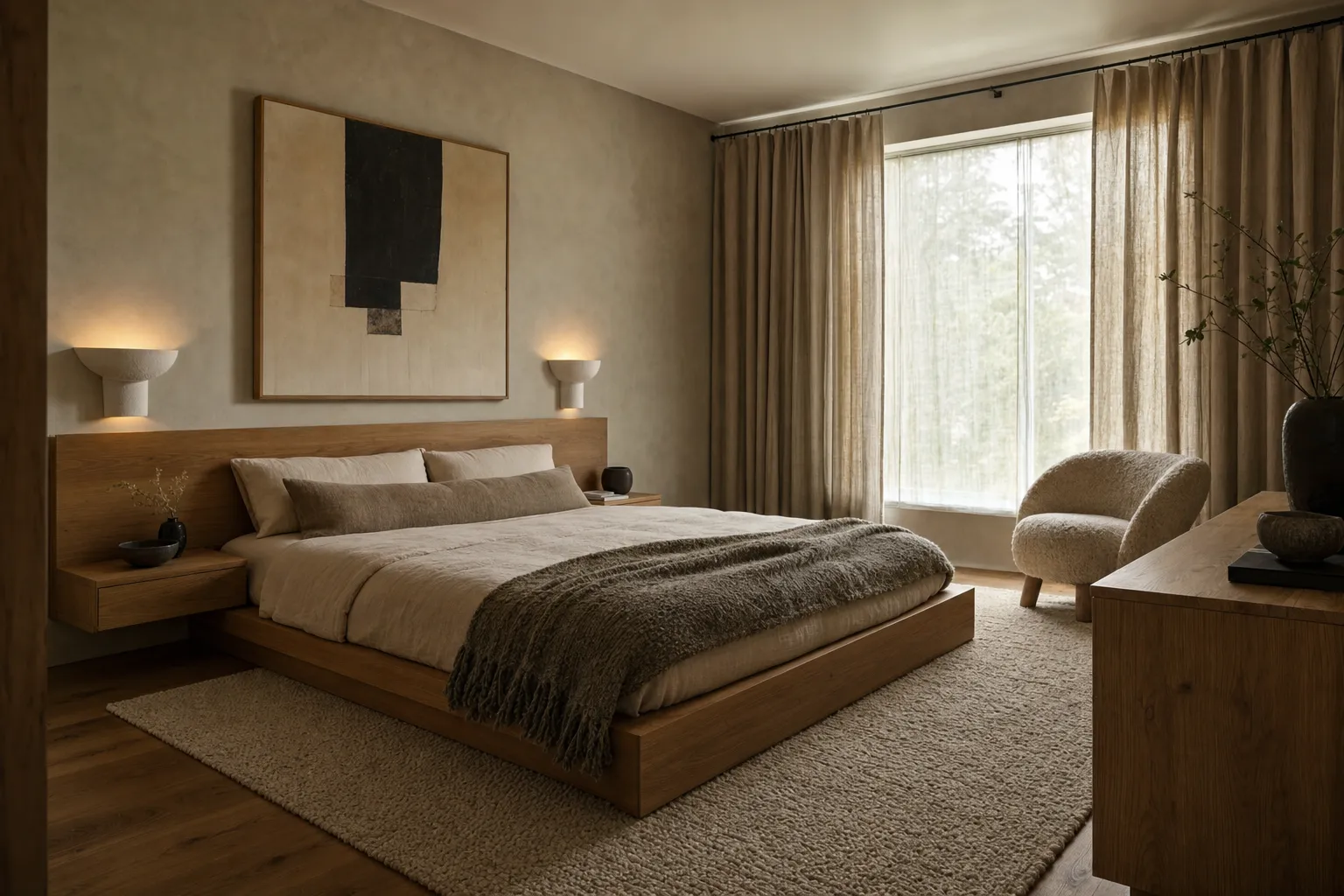
The principles of modern style
- Simplicity. Only the pieces the room needs, with space around them.
- Low profiles. Platform beds and low furniture make the room feel larger and calmer.
- Hidden storage. Built-in closets, drawers under the bed and handleless fronts keep surfaces clear.
- Warmth through texture. Wood, linen and wool keep a simple room from feeling cold.
Color palette
Warm whites, greige, soft gray, black accents and natural wood. For a darker, moodier modern bedroom, consider charcoal, deep green or navy on the headboard wall, balanced with light bedding.
Furniture
- A platform bed or a bed with a simple upholstered or wood headboard.
- Floating or simple nightstands, sometimes different on each side.
- A low dresser with clean fronts.
- One accent chair in a sculptural shape.
Lighting
Wall-mounted sconces or pendants beside the bed free the nightstands. A simple ceiling fixture on a dimmer and a hidden light strip behind the headboard add soft ambient light.
Walls and windows
One large artwork or photograph above the bed, or a textured wall treatment such as wood slats or limewash paint. Windows get simple linen curtains or blackout roller shades.
How to keep a modern bedroom from feeling cold
- Add a thick rug and layered bedding in natural fibers.
- Use at least two warm wood elements.
- Choose warm light and keep it low in the evening.
- Add one plant and a few personal objects.
Checklist: modern bedroom
0 of 6
Classic vs. modern bedroom: a quick comparison
The classic signature
- A centered bed with matching pairs
- Tufted, carved or four-poster beds
- Layered bedding and gentle patterns
- Warm woods, brass, linen, velvet
- Fabric-shade lamps, a small chandelier
Illustration
The modern signature
- Only the pieces the room needs
- Low platform bed and furniture
- Hidden, closed storage
- Warm neutrals and natural wood
- Wall sconces, soft hidden light
Illustration
| Classic (traditional) | Modern | |
|---|---|---|
| Organizing principle | Symmetry and layering | Simplicity and function |
| Bed | Upholstered, tufted, carved or four-poster | Platform or simple headboard |
| Palette | Soft classic colors, gentle patterns | Warm neutrals, wood, black accents |
| Textiles | Many layers, patterns, velvet and linen | Few layers, texture over pattern |
| Lighting | Table lamps with fabric shades | Sconces, pendants, hidden light |
| Storage | Dressers and chests on display | Built-in and hidden |
| Main risk | Looking heavy or overly matched | Looking cold or sterile |
Common bedroom decorating mistakes
- A bed too large for the room. Leave space to walk around it.
- Nightstands too small or too low. Keep them near mattress height and large enough for a lamp and a book.
- Only one overhead light. Bedrooms need soft, low light at night.
- No light control. Thin curtains let in morning light and streetlight.
- A rug that is too small. It should extend well beyond the sides of the bed.
- Too much furniture. A crowded room does not feel restful.
- Using the bedroom as storage. Boxes, laundry and exercise equipment in view make the room feel unfinished.
Frequently asked questions
Where should the bed go in a bedroom?
Usually against the longest solid wall, with a view of the door but not directly in line with it, and with clear space on both sides. Avoid placing it under a window when possible.
How can I make a small bedroom look bigger?
Use a light palette, a bed with legs or a low platform, wall-mounted lights instead of table lamps, and a large mirror. Choose storage that goes up, not out, and keep the floor as clear as possible.
What should I put on the wall above my bed?
One large artwork, a pair of framed prints, a large mirror, a textile or a simple shelf. Aim for about two thirds of the headboard's width and hang it about 8 to 10 inches above the headboard.
What size rug should go under a queen or king bed?
For a queen, an 8 x 10 foot rug works either way: placed lengthwise it leaves about 18 inches on each side, placed crosswise about 30. For a king, a 9 x 12 foot rug placed crosswise leaves about 34 inches per side; lengthwise, only about 16. The rug calculator on this page does the math for any bed size.
What colors are best for a bedroom?
Soft, muted colors such as warm white, beige, sage green and soft blue are the most popular choices for a restful bedroom. Darker colors can also work well on one wall if you prefer a cozy feel. Test samples in your room's light before painting.
How do I decorate a bedroom on a budget?
Start with the pieces that change the room most: bedding, a rug, curtains, lamps and one piece of wall art. Keep the furniture you have if it works, and add new pieces gradually.
See your own bedroom redesigned
Upload a photo of your bedroom, choose a style, and the Lilita's Studio system shows you your actual room redesigned in a classic, modern or other style, with a shopping list of real products for every piece.
- Your walls, windows and doors stay where they are.
- Bedding, lighting, rug and wall decor chosen to work together.
- Every piece in one list, with store, price and link.
$49.99 for three rooms · one-time · no subscription
Real rooms and style guides
Sources and further reading
- Wharton, Edith, and Ogden Codman Jr. The Decoration of Houses. New York: Charles Scribner's Sons, 1897.
- De Wolfe, Elsie. The House in Good Taste. New York: The Century Co., 1913.
- Morris, William. "The Beauty of Life," lecture, 1880. Published in Hopes and Fears for Art, 1882.
- Alexander, Christopher, Sara Ishikawa, and Murray Silverstein. A Pattern Language. New York: Oxford University Press, 1977.
- Ching, Francis D. K., and Corky Binggeli. Interior Design Illustrated. Hoboken: Wiley (first edition 1987).
- Conran, Terence. The House Book. London: Mitchell Beazley, 1974.
- Crawford, Ilse. A Frame for Life: The Designs of StudioIlse. New York: Rizzoli, 2014.
Illustrations on this page are for inspiration and are not photos of customer rooms. Photos marked Real room are customer rooms rendered by the Lilita's Studio system.