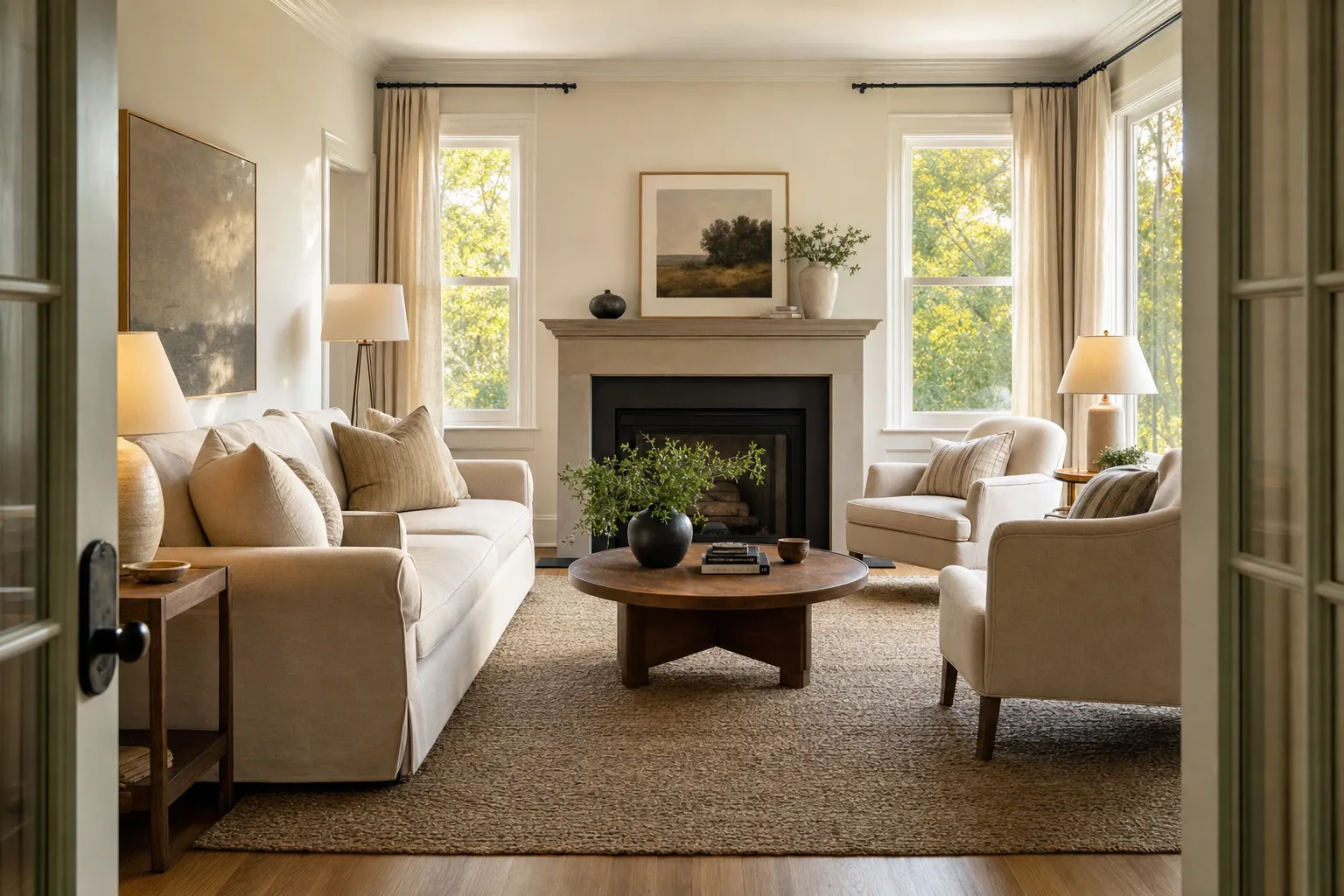
To decorate a living room well, start with how the room will be used, choose one focal point, arrange seating for conversation, then build in layers: rug, lighting, color, textiles, wall decor and a few personal objects. Whether you prefer a classic or a modern look, the same principles apply. They have been written down for more than a century by the authors this guide draws on, and they still work because they are based on how people actually live in a room.
This guide has three parts. First, the theory: what the foundational design books teach and how each idea applies to your living room. Second, a practical method with measurements you can use today. Third, two complete style guides, one for a classic living room and one for a modern living room.
Key takeaways
- Plan for function first: who uses the room, when, and for what.
- Pick one focal point and arrange the main seating around it.
- Keep a clear path of about 30 to 36 inches through the room.
- Use three layers of light: ambient, task and accent.
- Classic style relies on symmetry, proportion and traditional materials.
- Modern style relies on clean lines, restraint and warmth through texture.
The theory: what the great design books teach about living rooms
Interior decoration has a small set of foundational texts. You do not need to read all of them to decorate well, but knowing their core ideas helps you make decisions with confidence instead of guesswork.
Vitruvius
De architectura · 1st century BC
Good buildings need three qualities: firmitas (soundness), utilitas (usefulness) and venustas (beauty).
In your living room: Furniture that is well built, a layout that works for daily life, and a look that pleases you. If a piece fails the first two tests, beauty alone will not save it.
Andrea Palladio
The Four Books of Architecture · 1570
Rules of symmetry and harmonic proportion that shaped classical interiors for centuries.
In your living room: When a room feels off, it is often a proportion problem: a sofa too small for its wall, a rug floating in the middle of the floor, art too narrow for the furniture below it.
Edith Wharton and Ogden Codman Jr.
The Decoration of Houses · 1897
Often called the first modern book on interior decoration. Decoration should respect the architecture of the room, its doors, windows, fireplace and walls, rather than cover it up.
In your living room: Before you buy anything, look at what the room already gives you: a fireplace, a large window, a view, a tall ceiling. Build the design around it.
“Proportion is the good breeding of architecture.”
Elsie de Wolfe
The House in Good Taste · 1913
Widely considered the first professional American interior decorator, she summarized her approach in three words: simplicity, suitability and proportion.
In your living room: Suitability is the most useful for a living room: every object should suit the people who use the room. A white linen sofa may be beautiful, but it is not suitable for a family with young children and a dog.
William Morris
The Beauty of Life (lecture) · 1880
The most quoted rule in home decoration, a filter for everything you bring into a room.
In your living room: Before adding a new object to the living room, ask which of the two tests it passes.
“Have nothing in your houses that you do not know to be useful, or believe to be beautiful.”
Dorothy Draper
Decorating Is Fun! · 1939
Decorate with courage: bold color, generous scale and a clear point of view.
In your living room: A living room with only small, safe pieces often looks unfinished. One confident element, such as a large mirror, a strong color or an oversized lamp, gives the room character.
Christopher Alexander and colleagues
A Pattern Language · 1977
Design patterns that make spaces feel good to live in. Three apply directly here: Light on Two Sides of Every Room, Sitting Circle and Window Place.
In your living room: Arrange seats in a loose, roughly circular group with the paths passing beside it rather than through it, and if the room has a good window, give it a chair.
Francis D. K. Ching
Interior Design Illustrated · 1987
Interior design organized into clear principles: proportion, scale, balance, harmony, unity and variety, rhythm, and emphasis.
In your living room: They are the vocabulary behind every tip in this guide. One focal point is emphasis; repeating a color three times is rhythm.
Ilse Crawford
A Frame for Life · 2014
Good interiors are designed around human experience: how a room feels to sit in, touch and live with, not only how it photographs.
In your living room: Check comfort as seriously as appearance: seat depth, the softness of a rug underfoot, warm light in the evening.
Before you buy anything: plan the room
1. Define how the room is used
Write down the three main activities in your living room: conversation, watching TV, reading, playing with children, hosting guests. The activities decide the furniture. A room for hosting needs more seats; a room for movies needs a clear sightline to the screen and good light control.
2. Measure and draw a simple floor plan
Measure the length and width of the room, the position and size of doors and windows, radiators or vents, and electrical outlets. A sketch on paper is enough. This single step prevents the most common and most expensive mistake: furniture that does not fit.
3. Choose one focal point
Following Ching's principle of emphasis, choose one main focal point: a fireplace, a large window, a TV wall or a statement piece of art. If the room has two strong candidates, such as a fireplace and a TV, place them on the same wall or on adjacent walls so the seating can face both.
4. Plan the traffic
Leave a clear path of about 30 to 36 inches for walkways, and route traffic around the seating group rather than through it, as Alexander recommends. Doors should open freely and no one should have to squeeze past a chair to reach a window.
Coffee table to sofa
14 to 18 in
About two thirds of the sofa's length, at seat height or slightly lower.
Conversation distance
8 to 10 ft
Main seats within this range so people can talk comfortably.
Walkways
30 to 36 in
Clear paths around, not through, the seating group.
Rug
8 x 10 ft or larger
At least the front legs of the sofa and chairs on it.
Art above a sofa
2/3 of sofa width
Bottom edge about 8 to 10 inches above the sofa back.
Art on an open wall
57 to 60 in
Height of the artwork's center, as galleries commonly hang it.
General guidelines used by interior designers, not strict rules. Adjust them to your room.
Try it with your room
Living room sizer
Enter your sofa length and room size to get the coffee table, art and rug sizes that fit.
Coffee table
50 to 56 in
About two thirds of the sofa, 14 to 18 in away.
Art above the sofa
50 to 63 in wide
Bottom edge 8 to 10 in above the sofa back.
Rug
8 x 10 ft
Runs past both ends of the sofa, front legs on.
Rules of thumb for planning. Measure your space before you buy.
The seven layers of a well-decorated living room
Layer 1: Layout
Start with the largest piece, usually the sofa, and place it facing the focal point. Add chairs to form a conversation group. In larger rooms, float the furniture away from the walls; in smaller rooms, place the sofa against the longest wall to free the floor.
Layer 2: The rug
The rug defines the seating area and connects the pieces. A rug that is too small is one of the most common mistakes, because it breaks proportion. When in doubt, go one size larger.
Layer 3: Lighting
- Ambient light for general illumination: ceiling fixtures or several floor lamps.
- Task light for specific activities: a reading lamp beside a chair.
- Accent light for atmosphere: picture lights, table lamps on a console, lit shelves.
For living spaces, warm bulbs of about 2700K to 3000K create a comfortable evening atmosphere. Dimmers are one of the most effective and affordable upgrades you can make.
Layer 4: Color
A widely used starting point is the 60-30-10 guideline: about 60% of the room in a dominant color (walls, large rug), 30% in a secondary color (sofa, curtains) and 10% in an accent color (pillows, art, small objects). It is a rule of thumb, not a law, but it helps avoid both a flat room and a chaotic one. Repeating the accent color at least three times across the room creates rhythm.
Layer 5: Textiles and texture
Pillows, throws, curtains and upholstery add comfort and soften hard surfaces. Mix textures such as linen, wool, boucle, leather and velvet so the room feels layered even in a neutral palette. This is Ilse Crawford's lesson: a room should feel good, not only look good.
Layer 6: Wall decor
Wall decor is one of the fastest growing living room searches in the United States this year, and for good reason: it changes a room quickly and at a moderate cost. Options include one large piece of art, a gallery wall, a large mirror to reflect light, or open shelves. A single large piece usually looks more intentional than several small ones scattered across a wall.
Layer 7: Personal objects and plants
Finish with books, a few meaningful objects and plants. Group accessories in odd numbers and vary their heights. Apply William Morris's test to each item: useful or beautiful. If it is neither, it can go.
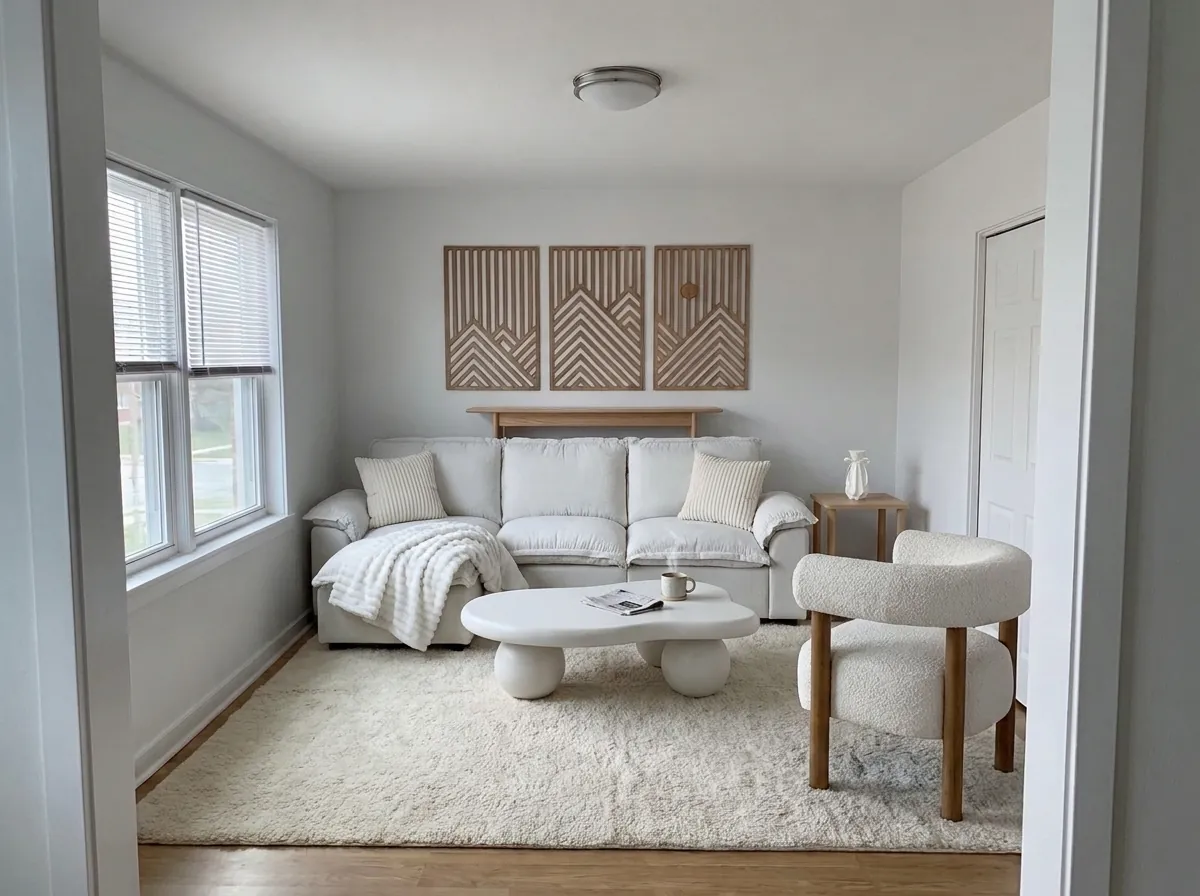 After
After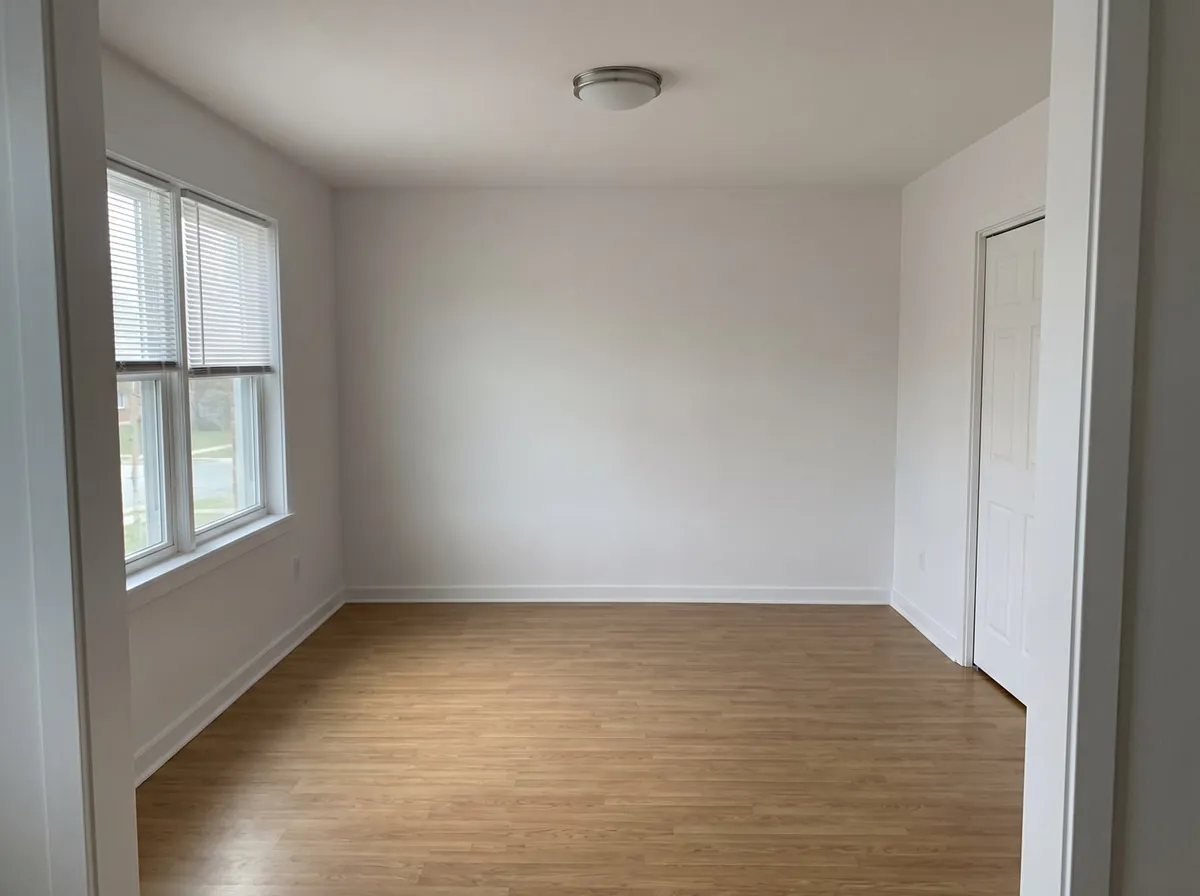
How to decorate a classic living room
A classic living room, also called a traditional living room, draws on European design from the 18th and 19th centuries and the American homes inspired by it. It feels calm, orderly and welcoming, and it rewards quality over quantity.
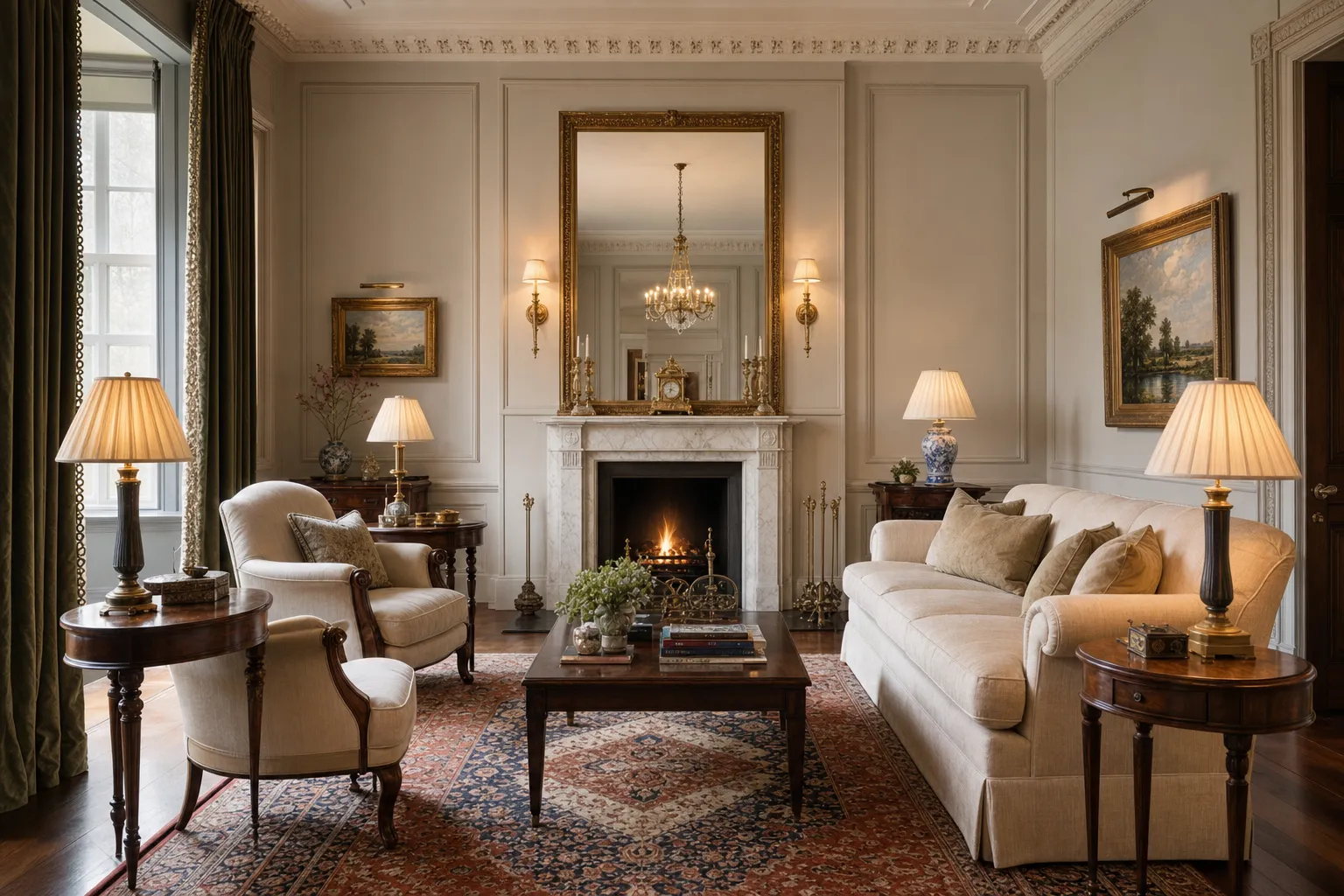
The principles of classic style
- Symmetry. The heart of classic style, inherited from Palladio. Place matching pieces on either side of a central axis: two armchairs facing each other, two lamps on a console, two sconces around a mirror.
- Proportion. Furniture scaled to the room and to the architecture, as Wharton and Codman recommend.
- Architecture as decoration. Moldings, paneling, a mantel and well-dressed windows are part of the design, not a background.
- Collected over time. A classic room looks as if it grew over years, not as if it arrived in one delivery.
Color palette
Warm, layered neutrals such as cream, ivory, taupe and soft gray, combined with deeper traditional colors: navy, forest green, burgundy or soft blue. Classic rooms use pattern in a controlled way, with one large pattern, one medium and one small.
Furniture
- A sofa with a defined silhouette: rolled arms, a tight back or tufting.
- A pair of upholstered armchairs or wingback chairs.
- A wood coffee table with turned or carved legs, or a large upholstered ottoman.
- Side tables and a console in wood tones such as walnut, mahogany or cherry.
- A bookcase or cabinet for display.
Materials and textiles
Wood, brass, marble, linen, velvet, damask and wool. Classic patterns include florals, stripes, toile, damask and paisley. Rugs are often Persian or Oriental in style, or a neutral sisal layered with a patterned rug.
Lighting
Table lamps with fabric shades, a chandelier or a traditional ceiling fixture, and sconces on either side of the fireplace or a mirror. Warm light is essential; classic rooms look their best in the evening.
Walls and windows
Framed art in gilt or wood frames, oil paintings or botanical prints, and a large mirror above the mantel. Curtains are full length, hung high, in linen or velvet, sometimes over Roman shades.
How to keep classic style from looking dated
- Leave some empty space. Classic does not mean crowded.
- Lighten the walls and keep the dark tones for furniture and textiles.
- Add one or two modern elements, such as an abstract painting or a simple lamp. This mix is known as modern traditional, the most searched traditional living room style in the United States this year.
Checklist: classic living room
0 of 7
How to decorate a modern living room
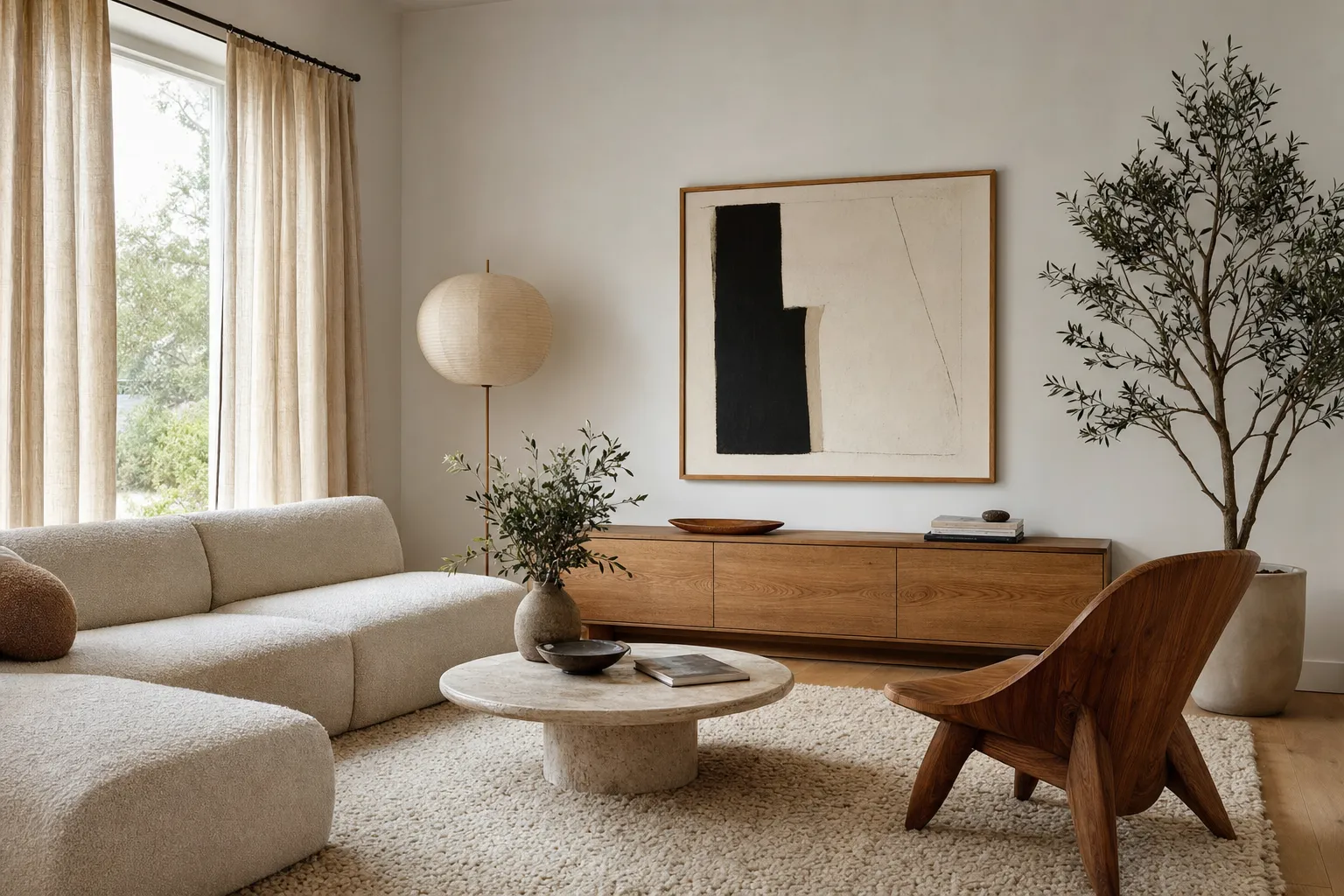
Modern is the most searched living room style in the United States by a wide margin. In interior design the word is used in two ways. Strictly, modern design refers to the movement of the early and mid 20th century, from the Bauhaus to mid-century modern. In everyday use, it means a clean, uncluttered and current look. Both share the same core principles.
The principles of modern style
- Function first. Le Corbusier famously called the house a machine for living in, in Toward an Architecture (1923). A modern living room is designed around use, with no ornament for its own sake.
- Less is more. A phrase closely associated with the architect Ludwig Mies van der Rohe. Fewer, better pieces, with room to breathe around them.
- Clean lines. Straight or gently curved silhouettes, low profiles, and furniture raised on slim legs so the floor stays visible.
- Honest materials. Wood, steel, glass, leather and stone, shown as they are.
Color palette
Neutral foundations such as white, warm white, gray, black and natural wood. Accent colors are used with restraint: one strong color, such as rust, olive, deep blue or mustard, repeated in two or three places. Neutral living rooms are one of the fastest rising searches this year, and they fit modern style naturally.
Furniture
- A low sofa with clean lines, often with track arms or a modular shape.
- One sculptural lounge chair as the statement piece.
- A simple coffee table in wood, stone or glass, often round or oval to soften the lines.
- A low media console that keeps the TV wall clean.
- Few side tables, chosen for shape as much as function.
Materials and textiles
Light or medium woods such as oak and walnut, black or brushed metal, glass, concrete, leather and wool. Patterns are geometric or absent. Texture replaces pattern: a boucle chair, a wool rug with a subtle weave, linen curtains.
Lighting
Modern rooms often rely on statement fixtures: a sculptural floor lamp, a globe pendant or an arc lamp over the sofa. Hidden sources, such as LED strips on shelves, add accent light without visual clutter.
Walls and windows
One large abstract artwork or a large-format photograph rather than many small frames. Frames are thin, in black, white or natural wood. Windows are dressed simply: linen curtains on a slim rod, or roller shades.
How to keep modern style from feeling cold
- Add natural wood in at least two or three pieces.
- Use a thick rug and textured textiles.
- Choose warm light, around 2700K, and add lamps at different heights.
- Bring in plants and a few personal objects.
Checklist: modern living room
0 of 7
Classic vs. modern living room: a quick comparison
The classic signature
- Symmetry around a central axis
- Rolled arms, carved legs, tufting
- Warm neutrals with navy, green or burgundy
- Walnut, brass, marble, velvet
- Table lamps, sconces, a chandelier
Illustration
The modern signature
- Function first, nothing for show
- Low, clean-lined silhouettes
- Neutral base with one accent color
- Light woods, stone, wool, leather
- One sculptural lamp, hidden light
Illustration
| Classic (traditional) | Modern | |
|---|---|---|
| Organizing principle | Symmetry and proportion | Function and restraint |
| Lines | Curved, detailed, ornamental | Clean, straight or softly curved |
| Palette | Warm neutrals with deep traditional colors | Neutral base with one accent |
| Pattern | Florals, stripes, damask, Persian rugs | Geometric or none; texture instead |
| Materials | Dark woods, brass, velvet, marble | Light woods, metal, glass, wool, leather |
| Lighting | Table lamps, chandeliers, sconces | Sculptural fixtures, hidden sources |
| Walls | Framed art, gilt mirrors, moldings | One large artwork, plain walls |
| Main risk | Looking crowded or dated | Looking cold or empty |
You do not have to choose one side. Many of the best living rooms combine a classic structure, such as symmetry and good proportion, with modern pieces. If you are unsure which style you prefer, look at the photos you save most often and notice what they have in common.
Common living room decorating mistakes
- Buying furniture before measuring. The most expensive mistake and the easiest to avoid.
- A rug that is too small. It makes the room look disconnected.
- Pushing every piece against the walls. In medium and large rooms, floating the seating creates a more welcoming group.
- Relying on one ceiling light. Rooms need several light sources at different heights.
- Art hung too high or too small. Follow the 57 to 60 inch guideline and the two thirds rule over furniture.
- Buying everything from one collection. The room looks like a showroom instead of a home.
- Too many small accessories. Fewer, larger objects look more intentional.
Frequently asked questions
How do I start decorating my living room?
Start with function and measurements. Decide how the room will be used, measure it, choose a focal point and plan the seating around it. Only then choose colors and buy furniture, starting with the largest pieces.
How can I make a small living room look bigger?
Choose furniture on raised legs, a light color palette and one large rug instead of several small ones. Hang curtains high and wide, add a large mirror beside or opposite a window, and avoid oversized sectionals that block paths.
What should I put on a large living room wall?
One large artwork, a large mirror, a gallery wall with a consistent frame color, or wall-mounted shelves. For a single piece above a sofa, aim for about two thirds of the sofa's width.
What is the difference between modern and contemporary living rooms?
Modern design refers to a specific 20th-century movement based on function and clean lines. Contemporary design describes what is current today and changes over time. In practice, many living rooms mix the two.
What is a modern traditional living room?
It combines the structure of classic style, such as symmetry, moldings and quality materials, with simpler modern furniture, lighter colors and less ornament. It is a good choice if you like classic warmth but prefer a cleaner look.
What colors work best in a living room?
Neutrals such as warm white, beige, greige and soft gray are the most flexible base. Add color through textiles and art, following the 60-30-10 guideline. Always test paint samples on your own walls, since natural light changes how a color looks.
See your own living room redesigned
Theory is a good start, but it is easier to decide when you can see the result in your own space. Upload a photo of your living room, choose a style, and the Lilita's Studio system redesigns your actual room and gives you a shopping list of real products you can buy.
- See your room in a classic, modern or any of our other styles.
- Your walls, windows and doors stay where they are.
- Every piece in one list, with store, price and link.
$49.99 for three rooms · one-time · no subscription
Real rooms and style guides
Sources and further reading
- Vitruvius. De architectura (The Ten Books on Architecture). 1st century BC.
- Palladio, Andrea. I quattro libri dell'architettura (The Four Books of Architecture). Venice, 1570.
- Wharton, Edith, and Ogden Codman Jr. The Decoration of Houses. New York: Charles Scribner's Sons, 1897.
- De Wolfe, Elsie. The House in Good Taste. New York: The Century Co., 1913.
- Morris, William. "The Beauty of Life," lecture, 1880. Published in Hopes and Fears for Art, 1882.
- Draper, Dorothy. Decorating Is Fun! How to Be Your Own Decorator. New York: Doubleday, Doran, 1939.
- Le Corbusier. Vers une architecture (Toward an Architecture). Paris, 1923.
- Alexander, Christopher, Sara Ishikawa, and Murray Silverstein. A Pattern Language. New York: Oxford University Press, 1977.
- Ching, Francis D. K., and Corky Binggeli. Interior Design Illustrated. Hoboken: Wiley (first edition 1987).
- Crawford, Ilse. A Frame for Life: The Designs of StudioIlse. New York: Rizzoli, 2014.
Illustrations on this page are for inspiration and are not photos of customer rooms. Photos marked Real room are customer rooms rendered by the Lilita's Studio system.